 en
en  Türkçe
 Español
 Русский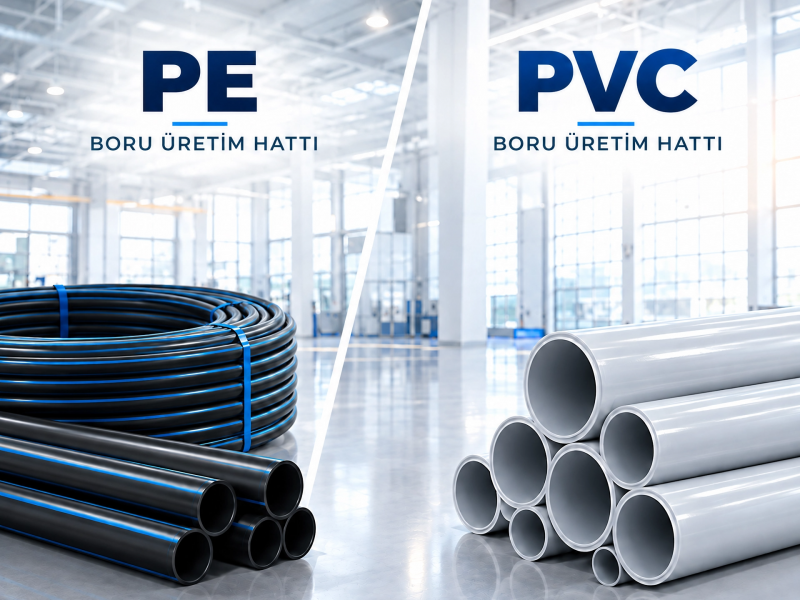
Short answer
If you sell the pipe in coils, a PE (coiled pipe) line is the right choice. If you sell it in fixed lengths, a rigid PVC line is the right choice. This distinction can be identified by the unit at the end of the line: the coiled pipe line has a fully automatic winding machine, while the rigid PVC line has a tilting table that stacks the cut products. Diameter range, capacity and cooling requirements also distinguish these two lines. The table below compares the technical values of DFC Makine's two lines.
Same purpose, two different production routes
Electrical conduit can be produced from both rigid PVC and polyethylene. Both serve the same basic purpose, but the product leaves the factory in a different form: rigid PVC pipe is cut into fixed lengths, bundled and shipped, while PE pipe is wound into coils. This single difference determines the structure of the production line from beginning to end.
DFC Makine manufactures both lines: the Rigid PVC Line (stock code DFC HAT 0005) and the Coiled Pipe Production Line (stock code DFC HAT 0002). The comparison below is based entirely on the technical data of these two lines.
Product form: coil or fixed length?
This is the first question to answer because the unit at the end of the line changes accordingly. In the Coiled Pipe Production Line, after the caterpillar haul-off comes a 2 × 1.5 kW fully automatic winding machine. The pipe is wound into a coil without stopping the production line. When the coil is completed, a 1.5 kW circular saw automatic cutter is activated, and a 3-meter pneumatic tilting table transfers the coil to the stacking area.
In the Rigid PVC Line, the product is not wound: a 1.5 kW automatic cutter cuts the product to the required length, and a 4-meter pneumatic tilting table unloads the cut lengths. Therefore, instead of trying to use the same line for both coiled and fixed-length production, the line should be selected according to your sales format.
Diameter range and capacity
The Coiled Pipe Production Line is offered with 12 different dies: Ø14, 16, 20, 25, 32, 40, 50, 63, 75, 90, 110 and 125 mm. The vacuum tank and cooling tank are also configured according to this range. The line operates at a capacity of 120 – 400 kg/hour, while the caterpillar haul-off can reach speeds of up to 2,500 m/hour.
These two figures should be considered together: the 2,500 m/hour speed is achieved with thin-wall pipes having a meter weight of 48 – 160 g, typically Ø16 – Ø32 mm concealed electrical conduit. As the diameter increases, the meter weight increases and the line slows down in meters per hour, while the capacity in kilograms remains the relevant production measure. The same principle applies to the Rigid PVC Line: 120 – 300 kg/hour capacity and 1,200 m/hour haul-off speed correspond to products with a meter weight of approximately 100 – 250 g.
It is more accurate to define your capacity target in kilograms rather than meters. To convert it into meters, you only need to know the meter weight of the pipe you plan to produce.
Cooling: the most visible difference between the two lines
PE pipe must be cooled sufficiently after leaving the die so that it can be wound into a coil. For this reason, the Coiled Pipe Production Line has a 3 – 6 meter vacuum tank followed by an additional 3 – 12 meter cooling tank. In the Rigid PVC Line, a 3 – 6 meter vacuum table is sufficient.
The practical result is that the coiled pipe line requires a longer installation area at the same capacity. When planning the factory layout, the cooling tank length of 3 – 12 meters should be selected according to the target line speed.
Raw material and recycling
Both lines are designed to operate with virgin and recycled raw materials. The difference lies in the filtration configuration: the Coiled Pipe Production Line includes a 2 × 120 mm hydraulic filter unit as standard, while the raw material feeding unit of the Rigid PVC Line can be supplied with double filtration upon request.
If you plan to use recycled raw material, this unit directly affects the number of production stops required for die cleaning. It is therefore useful to ask specifically about the filtration configuration when requesting a quotation.
What does the material itself tell you?
Rigid PVC (U-PVC) pipe is hard and maintains its shape. It is transported in fixed lengths, joined with fittings and provides a straight route in installation. DFC's Rigid PVC Line page also states that the line can be used for rigid PVC product groups such as doors and windows, meaning the line is not limited to pipe production and can also be configured for rigid PVC profiles.
Polyethylene pipe is flexible and can be transported in coils. Because it is supplied in long continuous lengths, it can reduce the number of joints and adapt to curved concealed installations. DFC's Coiled Pipe Production Line page states that the line can be used for both concealed electrical conduit and irrigation pipe production, allowing the same line to serve two different markets.
Rigid PVC Line vs. Coiled (PE) Line: side-by-side comparison
All values below are taken from the technical tables on DFC Makine's two product pages.
| CRITERIA | RIGID PVC LINE | COILED PIPE PRODUCTION LINE |
|---|---|---|
| Stock code | DFC HAT 0005 | DFC HAT 0002 |
| Raw material | Rigid PVC (U-PVC) — virgin + recycled | Polyethylene — virgin + recycled |
| Product form | Fixed length (cut product) | Coil (wound pipe) |
| End-of-line unit | Automatic cutter + tilting table | Automatic winding machine + cutter + tilting table |
| Extruder power | 45 – 110 kW | 22 – 90 kW (main) + 1.5 kW (auxiliary) |
| Extruder screw diameter | Ø63 – 89 mm | Ø70 – 120 mm |
| Capacity | 120 – 300 kg/h | 120 – 400 kg/h |
| Maximum haul-off speed | 1,200 m/h | 2,500 m/h |
| Cooling | Vacuum table 3 – 6 meters | Vacuum tank 3 – 6 m + cooling tank 3 – 12 m |
| Pipe diameter / die | Determined by die and calibration selection | Ø14 – 125 mm — 12 dies |
| Filter | Double-filter haul-off unit (optional) | 2 × 120 mm hydraulic filter unit (included) |
| Application | Doors, windows and other rigid PVC products | Concealed electrical conduit, irrigation pipe |
| Control | Single PLC panel, synchronized | Single PLC panel, synchronized |
| Delivery | Turnkey line | Turnkey line or individual units |
Making the decision in five questions
Clarify these five questions before requesting a quotation and the appropriate line will become much clearer:
- Will you sell your product in coils or fixed lengths?
If it is coiled, you need a line with a winding machine. If it is fixed length, you need a cutting and stacking system. - What diameter range will you produce?
The coiled line offers 12 die options between Ø14 – 125 mm. Providing your target diameters in advance makes the die and calibration list clear. - Is your capacity target in kilograms or meters?
A kilogram target directly defines the production requirement (120 – 400 kg/h). A meter target only becomes meaningful when the pipe's meter weight is known. - Will you use recycled raw material?
If yes, include the required filter configuration in the quotation because it directly affects production downtime. - How much space can you allocate for the line?
The cooling tank alone can be 3 – 12 meters long on the coiled line, so the layout should be planned together with the target line speed.
Frequently Asked Questions
Should I buy a PVC line or a PE line to produce electrical conduit?
If you will sell the pipe in coils, the PE coiled pipe line is suitable. If you will sell it cut to fixed lengths, the rigid PVC line is suitable. DFC Makine's Coiled Pipe Production Line is designed for concealed electrical conduit and irrigation pipe production and includes a fully automatic winding machine at the end of the line. The Rigid PVC Line cuts the product to the required length and unloads it through a pneumatic tilting table.
What is the capacity difference between the PE coiled line and the rigid PVC line?
The Coiled Pipe Production Line operates at 120 – 400 kg/hour with haul-off speeds of up to 2,500 m/hour. The Rigid PVC Line operates at 120 – 300 kg/hour with haul-off speeds of up to 1,200 m/hour. In both lines, the speed in meters depends on the meter weight of the product.
Can I produce both PVC and PE pipe on the same line?
The two lines have different components: the coiled line includes a winding machine and an additional cooling tank, while the rigid PVC line does not. For exact information about which material can be processed with which configuration, you should contact DFC Makine's engineering team.
What diameters can the coiled pipe line produce?
The line is offered with 12 different dies: Ø14, 16, 20, 25, 32, 40, 50, 63, 75, 90, 110 and 125 mm. The vacuum and cooling tanks are also configured for the Ø14 – Ø125 mm range.
Can both lines work with recycled raw material?
Yes. The polyethylene raw material used in the Coiled Pipe Production Line can be virgin or recycled, and the line includes a 2 × 120 mm hydraulic filter unit. The Rigid PVC Line can also operate with virgin and recycled PVC, and the raw material feeding unit can be supplied with double filtration when requested.
Do I have to purchase the complete line?
The Coiled Pipe Production Line can be supplied as a complete line or as individual units. It is possible to add only a winding machine, haul-off or cooling tank to an existing line, depending on the project.
To determine which line suits your operation, simply provide us with your planned pipe diameter, meter weight and monthly production target. We can configure the line accordingly and prepare a quotation.