DFC

Every Detail Powers Better Manufacturing.

DFC Machinery & Engineering

HVAC Duct Machines & Plastic Pipe & Hose Production Lines

The Strategic Power of Manufacturing!

about us
DFC Machinery & Engineering
Experience tomorrow’s technology today with DFC Machinery & Engineering

The Machine Technology of the Future, With You Today

DFC Makine & Mühendislik is a leading manufacturer operating on a global scale in the HVAC and plastic machinery sectors, backed by 23 years of experience. Through our innovative engineering approach, strong R&D capabilities, and quality-focused production, we develop high-performance, reliable, and long-lasting machine solutions tailored to different needs.

Combining our manufacturing capabilities with international experience, we export to 50 countries across 6 continents, including Italy, Switzerland, Germany, Algeria, and Russia. We closely analyze the requirements of different markets and continuously improve our solutions by following technological developments and industry expectations.

At DFC Makine & Mühendislik, we do more than manufacture machinery; we provide long-term and sustainable solutions for our business partners. From project development and manufacturing to installation, commissioning, and after-sales technical support, we stand by our customers at every stage.

With our local manufacturing strength, engineering expertise, and global service approach, we continue to develop technologies that create value for the needs of the industry today and in the future.


Warranty and Technical Support

Our after-sales service standards and warranty conditions.

2-Year Warranty

2-year mechanical and 2-year electronic warranty is provided.

Fast Technical Service

Technical service is provided in Türkiye and abroad within 1–3 business days.

10-Year Spare Parts Guarantee

10-year spare parts supply guarantee is provided. Depending on stock availability, shipment can be made on the same day.

  • 01.
    Remote Access and Automation Support
    Using our internet-based automation system, machines can be accessed remotely to identify issues and provide immediate PLC and automation support.
  • 02.
    Installation and Training Services
    Installation, commissioning, and operator training are included in the delivery.
  • 03.
    Warranty and On-Site Service Coverage
    During the warranty period, for machine-related failures, not only the parts but also the required service is covered under warranty; where necessary, travel and accommodation expenses are covered by DFC Machinery.
About Us
DFC MAKİNE

HVAC Machinery

Spiral duct machine, round elbow machine, CNC plasma machine, square and oval duct machines, flange and clamping machines.

Discover
01
DFC MAKİNE

Plastic Pipe and Hose Production Machines

Plastic extruder machines, granulator machines, hose and pipe pullers, automatic winding machines, vacuum and cooling pools, hose braiding drums, various types of molds, and plastic recycling machines.

Discover
02
DFC MAKİNE

Plastic Pipe and Hose Production Lines

Our turnkey solutions include Kangal pipe production lines, corrugated pipe lines, PPRC and HDPE polyethylene pipe lines, rigid PVC lines, and PVC natural, braided, and spiral hoses, as well as drip irrigation/sprinkler lines.

Discover
03
DFC Machinery & Engineering
catalogs

Catalogs

Browse our documents and catalogs to get more information about our products. Review them now to discover the most suitable solution for you!

Catalogs
DFC Machinery & Engineering

Produced in Türkiye, preferred by the world

50

Export to Country

Uninterrupted quality from engineering to production

23

Years Experience

DFC Machinery & Engineering

Get to know our brand closely

News
News

DFC Updates

16 Oct 2025

HVAC Duct Machinery: A Production Approach That Simplifies Your Work

For many businesses, duct production is not just a machine investment—it is a decision that defines the rhythm of operations. Deadlines become tighter, projects diversify, and maintaining consistent quality every day becomes essential. DFC Makine’s HVAC duct machinery offers an approach that simplifies operations rather than complicating them in this demanding pace. Fast installation and ease of learning ensure that your team can start production with confidence in a short time.

What matters most in daily operations is clear: predictable results. When it comes to seam quality, dimensional consistency, and surface finish, being able to confidently say “Will I get the same quality tomorrow as I do today?” is a major advantage. This is exactly what we focus on. By providing training, maintenance guidance, and spare parts support from a single source, we help ensure stable and uninterrupted production lines.

When starting a new project or expanding capacity, choosing the right partner is key to avoiding uncertainty. DFC Makine offers practical user experience, fast commissioning, and accessible on-site support in HVAC duct machinery. For detailed product information and technical specifications, please visit our HVAC Duct Machines page. For quotation or demo requests, you can contact us through our Contact page.

16 Oct 2025

Plastic Pipe Production Lines: Facilitating Consistent Quality

The goal in plastic pipe production is actually simple: delivering consistent quality for every order, on schedule, and at sustainable costs. In practice, however, factors such as raw material variability, intensive production schedules, and staff turnover can make things challenging. DFC Makine designs a user experience for PPRC, PVC, and PE pipe lines that makes processes clear and allows operators to adapt quickly. This reduces surprises on the production line and keeps quality fluctuations under control.

You can tell a line is truly working well on days when it doesn’t interrupt workflow. Transitions proceed smoothly, dimensions and surface finish meet expectations, and maintenance plans are executed without delays. We approach installation and training within this framework. Together, we plan the line structure according to your target product range, complete commissioning on schedule, and support daily operations with after-sales service.

For those investing in new equipment or expanding capacity, confidence is invaluable. DFC Makine facilitates consistent quality in pipe production lines and helps you maintain control as you grow. For more information, visit your “Plastic Pipe Production Lines” page, and for inquiries, your “Contact” page.

28 Sep 2026

PVC or PE? Choosing the Right Production Line for Electrical Conduits

28 Sep 2026 · Plastic Pipe Production Lines

Same purpose, two different production routes

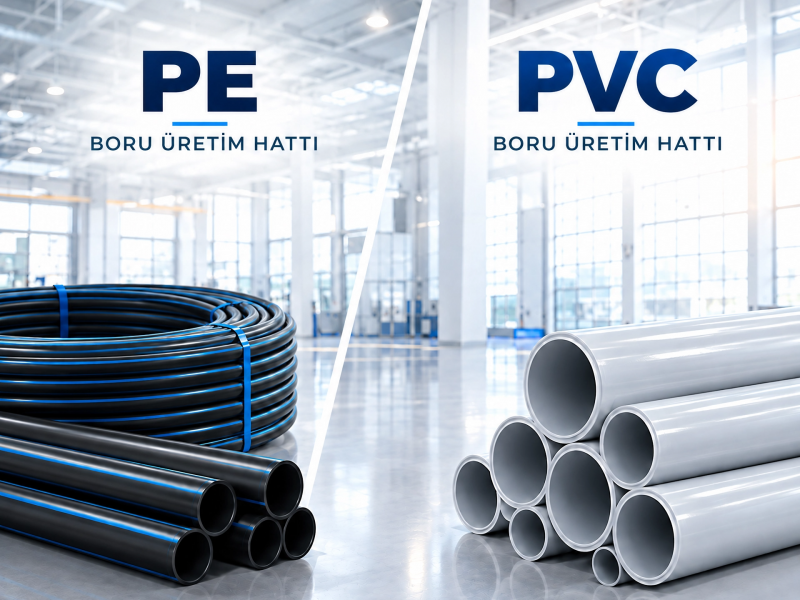
Electrical conduit can be produced from both rigid PVC and polyethylene. Both serve the same basic purpose, but the product leaves the factory in a different form: rigid PVC pipe is cut into fixed lengths, bundled and shipped, while PE pipe is wound into coils. This single difference determines the structure of the production line from beginning to end.

DFC Makine manufactures both lines: the Rigid PVC Line (stock code DFC HAT 0005) and the Coiled Pipe Production Line (stock code DFC HAT 0002). The comparison below is based entirely on the technical data of these two lines.

Product form: coil or fixed length?

This is the first question to answer because the unit at the end of the line changes accordingly. In the Coiled Pipe Production Line, after the caterpillar haul-off comes a 2 × 1.5 kW fully automatic winding machine. The pipe is wound into a coil without stopping the production line. When the coil is completed, a 1.5 kW circular saw automatic cutter is activated, and a 3-meter pneumatic tilting table transfers the coil to the stacking area.

In the Rigid PVC Line, the product is not wound: a 1.5 kW automatic cutter cuts the product to the required length, and a 4-meter pneumatic tilting table unloads the cut lengths. Therefore, instead of trying to use the same line for both coiled and fixed-length production, the line should be selected according to your sales format.

Diameter range and capacity

The Coiled Pipe Production Line is offered with 12 different dies: Ø14, 16, 20, 25, 32, 40, 50, 63, 75, 90, 110 and 125 mm. The vacuum tank and cooling tank are also configured according to this range. The line operates at a capacity of 120 – 400 kg/hour, while the caterpillar haul-off can reach speeds of up to 2,500 m/hour.

These two figures should be considered together: the 2,500 m/hour speed is achieved with thin-wall pipes having a meter weight of 48 – 160 g, typically Ø16 – Ø32 mm concealed electrical conduit. As the diameter increases, the meter weight increases and the line slows down in meters per hour, while the capacity in kilograms remains the relevant production measure. The same principle applies to the Rigid PVC Line: 120 – 300 kg/hour capacity and 1,200 m/hour haul-off speed correspond to products with a meter weight of approximately 100 – 250 g.

It is more accurate to define your capacity target in kilograms rather than meters. To convert it into meters, you only need to know the meter weight of the pipe you plan to produce.

Cooling: the most visible difference between the two lines

PE pipe must be cooled sufficiently after leaving the die so that it can be wound into a coil. For this reason, the Coiled Pipe Production Line has a 3 – 6 meter vacuum tank followed by an additional 3 – 12 meter cooling tank. In the Rigid PVC Line, a 3 – 6 meter vacuum table is sufficient.

The practical result is that the coiled pipe line requires a longer installation area at the same capacity. When planning the factory layout, the cooling tank length of 3 – 12 meters should be selected according to the target line speed.

Raw material and recycling

Both lines are designed to operate with virgin and recycled raw materials. The difference lies in the filtration configuration: the Coiled Pipe Production Line includes a 2 × 120 mm hydraulic filter unit as standard, while the raw material feeding unit of the Rigid PVC Line can be supplied with double filtration upon request.

If you plan to use recycled raw material, this unit directly affects the number of production stops required for die cleaning. It is therefore useful to ask specifically about the filtration configuration when requesting a quotation.

What does the material itself tell you?

Rigid PVC (U-PVC) pipe is hard and maintains its shape. It is transported in fixed lengths, joined with fittings and provides a straight route in installation. DFC's Rigid PVC Line page also states that the line can be used for rigid PVC product groups such as doors and windows, meaning the line is not limited to pipe production and can also be configured for rigid PVC profiles.

Polyethylene pipe is flexible and can be transported in coils. Because it is supplied in long continuous lengths, it can reduce the number of joints and adapt to curved concealed installations. DFC's Coiled Pipe Production Line page states that the line can be used for both concealed electrical conduit and irrigation pipe production, allowing the same line to serve two different markets.

Rigid PVC Line vs. Coiled (PE) Line: side-by-side comparison

All values below are taken from the technical tables on DFC Makine's two product pages.

CRITERIA RIGID PVC LINE COILED PIPE PRODUCTION LINE
Stock code DFC HAT 0005 DFC HAT 0002
Raw material Rigid PVC (U-PVC) — virgin + recycled Polyethylene — virgin + recycled
Product form Fixed length (cut product) Coil (wound pipe)
End-of-line unit Automatic cutter + tilting table Automatic winding machine + cutter + tilting table
Extruder power 45 – 110 kW 22 – 90 kW (main) + 1.5 kW (auxiliary)
Extruder screw diameter Ø63 – 89 mm Ø70 – 120 mm
Capacity 120 – 300 kg/h 120 – 400 kg/h
Maximum haul-off speed 1,200 m/h 2,500 m/h
Cooling Vacuum table 3 – 6 meters Vacuum tank 3 – 6 m + cooling tank 3 – 12 m
Pipe diameter / die Determined by die and calibration selection Ø14 – 125 mm — 12 dies
Filter Double-filter haul-off unit (optional) 2 × 120 mm hydraulic filter unit (included)
Application Doors, windows and other rigid PVC products Concealed electrical conduit, irrigation pipe
Control Single PLC panel, synchronized Single PLC panel, synchronized
Delivery Turnkey line Turnkey line or individual units

Making the decision in five questions

Clarify these five questions before requesting a quotation and the appropriate line will become much clearer:

  1. Will you sell your product in coils or fixed lengths?
    If it is coiled, you need a line with a winding machine. If it is fixed length, you need a cutting and stacking system.
  2. What diameter range will you produce?
    The coiled line offers 12 die options between Ø14 – 125 mm. Providing your target diameters in advance makes the die and calibration list clear.
  3. Is your capacity target in kilograms or meters?
    A kilogram target directly defines the production requirement (120 – 400 kg/h). A meter target only becomes meaningful when the pipe's meter weight is known.
  4. Will you use recycled raw material?
    If yes, include the required filter configuration in the quotation because it directly affects production downtime.
  5. How much space can you allocate for the line?
    The cooling tank alone can be 3 – 12 meters long on the coiled line, so the layout should be planned together with the target line speed.

Frequently Asked Questions

Should I buy a PVC line or a PE line to produce electrical conduit?

If you will sell the pipe in coils, the PE coiled pipe line is suitable. If you will sell it cut to fixed lengths, the rigid PVC line is suitable. DFC Makine's Coiled Pipe Production Line is designed for concealed electrical conduit and irrigation pipe production and includes a fully automatic winding machine at the end of the line. The Rigid PVC Line cuts the product to the required length and unloads it through a pneumatic tilting table.

What is the capacity difference between the PE coiled line and the rigid PVC line?

The Coiled Pipe Production Line operates at 120 – 400 kg/hour with haul-off speeds of up to 2,500 m/hour. The Rigid PVC Line operates at 120 – 300 kg/hour with haul-off speeds of up to 1,200 m/hour. In both lines, the speed in meters depends on the meter weight of the product.

Can I produce both PVC and PE pipe on the same line?

The two lines have different components: the coiled line includes a winding machine and an additional cooling tank, while the rigid PVC line does not. For exact information about which material can be processed with which configuration, you should contact DFC Makine's engineering team.

What diameters can the coiled pipe line produce?

The line is offered with 12 different dies: Ø14, 16, 20, 25, 32, 40, 50, 63, 75, 90, 110 and 125 mm. The vacuum and cooling tanks are also configured for the Ø14 – Ø125 mm range.

Can both lines work with recycled raw material?

Yes. The polyethylene raw material used in the Coiled Pipe Production Line can be virgin or recycled, and the line includes a 2 × 120 mm hydraulic filter unit. The Rigid PVC Line can also operate with virgin and recycled PVC, and the raw material feeding unit can be supplied with double filtration when requested.

Do I have to purchase the complete line?

The Coiled Pipe Production Line can be supplied as a complete line or as individual units. It is possible to add only a winding machine, haul-off or cooling tank to an existing line, depending on the project.

To determine which line suits your operation, simply provide us with your planned pipe diameter, meter weight and monthly production target. We can configure the line accordingly and prepare a quotation.
Related Product Pages

14 Oct 2026

Round Elbow Machine Buying Guide: Diameter, Thickness, Power, Air Supply and Warranty

14 Oct 2026 · HVAC Machinery

What does a Round Elbow Machine do?

A round elbow machine produces the elbows, fittings and end caps used in ventilation duct systems. An elbow is made by fitting round segments into each other and seaming them; the machine prepares these segments and joins them.

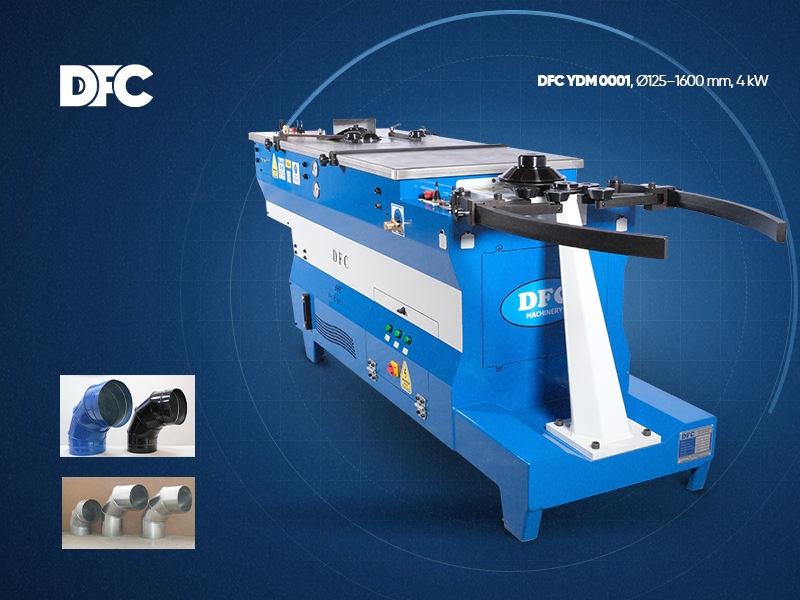
The DFC Round Elbow Machine has two stations. At the first station male and female flange seats are formed on the segments; at the second station the segments are assembled and closed. The rollers in the seaming and closing units are driven by hydraulic motors and hydraulic pistons, and two operators can work on the machine at the same time. The same machine produces elbows and reducers in 0.5 – 1.2 mm sheet.

1. Diameter range: your smallest and largest elbow

The first value to check is whether the machine’s diameter range covers your projects. Residential and office ventilation uses smaller diameters, industrial plants larger ones; both ends of the range should fit your work.

The DFC Round Elbow Machine produces from Ø125 mm to Ø1600 mm. Seaming rollers are supplied in three sizes (6 – 7.5 – 10 mm, 3 sets), so small and large diameters can be produced on the same machine.

2. Sheet thickness and material

Galvanized and stainless steel sheet have different thickness limits; a quotation should state both separately.

The DFC Round Elbow Machine works with 0.5 – 1.2 mm galvanized and 0.5 – 1 mm stainless steel sheet. Its bending and pressing rollers are made of wear-resistant 2379 cold work tool steel.

3. Power and electricity

Power draw determines the electrical infrastructure you need and your running cost. Mains frequency (50 or 60 Hz) differs by country, so it should be written clearly in the quotation.

The DFC Round Elbow Machine draws 4 kW and runs on 380 V / 3-phase, 50/60 Hz. Hydraulic oil capacity is 90 litres; plan this amount for the first fill.

4. Air supply: do you need a compressor?

Some machines need compressed air to operate. In that case a compressor, air line and air treatment unit become part of the investment; always ask about this when comparing quotations.

The DFC Round Elbow Machine is driven by hydraulic motors and pistons and does not require compressed (pneumatic) air. A 380 V power connection is enough to install it.

5. Cycle time and number of operators

How long one elbow takes depends on the diameter, sheet thickness and the number of segments in the elbow. Instead of a single “X elbows per minute” figure, ask for a measured time for the diameter and thickness you will produce, and if possible see the machine running (at the factory or on video).

Look at the operator layout as well. On the DFC Round Elbow Machine the two stations can run at the same time with two operators: one forms the flange seats on the segments while the other assembles and closes. Male-female adjustment and transfer arm adjustment are automatic.

6. Floor space and weight

Plan floor space by adding the working area of two operators and storage for segments and finished elbows to the main body dimensions.

The main body of the DFC Round Elbow Machine measures 1000 × 3150 × 1250 mm (width × depth × height) and weighs 920 kg.

Buying checklist

All DFC values in the table come from the Round Elbow Machine product page and technical file. Fill in the same rows for every quotation you compare.

CRITERION WHAT TO CHECK DFC YDM 0001
Diameter range Are your smallest and largest elbows inside the range? Ø125 – 1600 mm
Galvanized sheet thickness Is your thickest sheet below the upper limit? 0.5 – 1.2 mm
Stainless steel sheet If you work with stainless, is a separate value given? 0.5 – 1 mm
Seaming rollers Are roller sets for small and large diameters included? 6 – 7.5 – 10 mm, 3 sets
Power Is your electrical infrastructure sufficient? 4 kW
Electricity Do mains voltage and frequency match? 380 V / 3-phase, 50/60 Hz
Compressed air Are a compressor and air line required? Not required (hydraulic)
Hydraulic oil How much oil for the first fill? 90 lt
Stations / operators How many people can work at the same time? 2 stations, 2 operators
Cycle time Is there a measured time for your diameter and thickness? Depends on diameter, thickness and number of segments; ask for your own size in the quotation
Roller material What are the bending and pressing rollers made of? 2379 cold work tool steel
Main body size / weight Floor space and handling plan 1000 × 3150 × 1250 mm · 920 kg

Warranty and service comparison table

Compare warranties by coverage, not only by duration. Make sure every row below is written in your quotation.

ITEM DFC YDM 0001 ASK IN THE QUOTATION
Mechanical warranty 2 years Which parts does it cover?
Electronic warranty 2 years Is it the same length as the mechanical warranty?
Bending and pressing rollers 50,000-hour wear guarantee (excluding user error) Is there a separate wear guarantee for the rollers?
Spare parts supply 10 years; same-day shipment when in stock For how many years are parts guaranteed in writing?
Technical service response 1 – 3 business days in Türkiye and abroad How many days after a fault report does service arrive?
Installation, commissioning, operator training Included with delivery Included in the price or charged separately?
On-site service under warranty Parts and service included for machine-related failures; travel and accommodation covered by DFC Makine where necessary Who pays travel and accommodation for service visits?

Six questions to decide

Answer these six questions before you request quotations, and you can compare the offers on the same basis.

  1. Which elbow diameters will you produce?
    Write down your smallest and largest diameter. The DFC Round Elbow Machine works from Ø125 to 1600 mm.
  2. Which material and thickness will you use?
    Compare the limits of 0.5 – 1.2 mm for galvanized and 0.5 – 1 mm for stainless steel with your own work.
  3. Do you have 380 V 3-phase power in the workshop?
    The machine draws 4 kW and runs on 50/60 Hz mains.
  4. Do you have a compressed-air line?
    Not needed: the DFC Round Elbow Machine is hydraulic and does not require a compressor.
  5. How many operators will you use?
    The two stations can run at the same time with two operators; if you plan to run it with one operator, say so at the quotation stage.
  6. Are warranty, spare parts and service in writing?
    Look for every row of the warranty table above in the quotation.

Frequently Asked Questions

What should I check when buying a round elbow machine?

Diameter range, galvanized and stainless sheet thickness, power and electricity, compressed-air requirement, cycle time and warranty/service coverage. Write these six values into the same table for every quotation and compare.

What diameters and thicknesses does the DFC Round Elbow Machine handle?

Ø125 – 1600 mm diameter, 0.5 – 1.2 mm galvanized and 0.5 – 1 mm stainless steel sheet. Three sets of seaming rollers (6 – 7.5 – 10 mm) are supplied for small and large diameters.

Does a round elbow machine need compressed air?

The DFC Round Elbow Machine is driven by hydraulic motors and pistons and does not need compressed air. A 380 V / 3-phase power connection is enough for installation.

How much power does the machine draw?

4 kW, on 380 V / 3-phase, 50/60 Hz mains. Hydraulic oil capacity is 90 litres.

How many operators are needed?

The machine has two stations and two operators can work at the same time: male and female flange seats are formed on the segments at the first station, assembly and closing are done at the second.

Which countries has the DFC Round Elbow Machine been exported to?

It has been exported to 44 countries, including Azerbaijan, Qatar, Kosovo, Lithuania and Algeria.

Send us the diameter range you will produce, your sheet thickness and your workshop’s power supply, and we will prepare the DFC Round Elbow Machine quotation and technical file accordingly.

Related Product Pages

DFC Machinery & Engineering DFC Machinery & Engineering

Service Request Form

Do you need support or repair? Would you like to have your machines updated or maintained?
DFC Machinery & Engineering